
Einstein and Spacetime Geometry
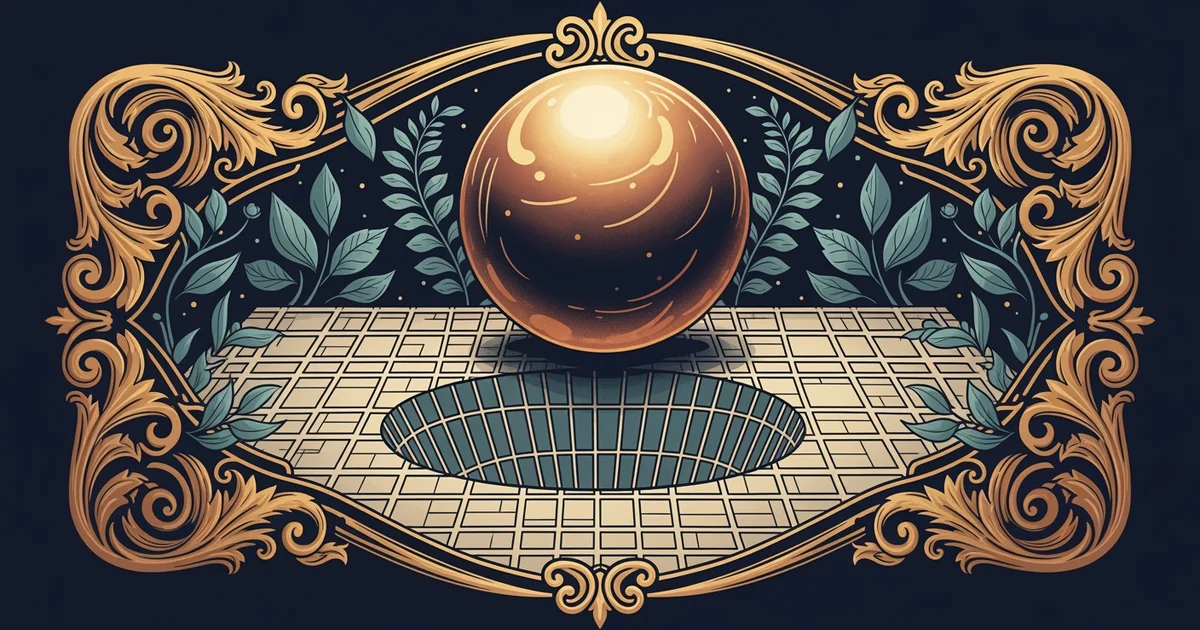
Imagine you roll a heavy marble across a soft rubber sheet stretched tight across a frame. When the marble moves in a straight line, it suddenly curves as it nears a heavy lead weight sitting on the fabric. Gravity works much like this marble moving across the fabric, as it is not a mysterious force pulling from afar. Instead, massive objects like stars or planets warp the very fabric of the universe, forcing everything else to follow the new shape.
Understanding the Geometry of Space
To grasp how gravity functions, you must view space and time as a single, flexible fabric called spacetime. This four-dimensional structure acts like a giant trampoline that reacts to whatever mass you place upon it. When you place a heavy object in the center, the fabric dips and stretches to accommodate that weight. Anything moving near that object will naturally roll toward the dip because the shortest path has become a curve. This geometric shift explains why planets orbit stars without needing an invisible rope to hold them in place.
Key term: Spacetime — the four-dimensional combination of space and time that warps and curves in the presence of matter.
This curvature defines the path of all objects moving through the universe, including light itself. If you were to shine a laser beam past a massive planet, the light would follow the curve of space rather than traveling in a straight line. This bending happens because the planet has changed the local geometry of the region around it. The object does not feel a force pulling it inward, as it is simply moving along the straightest possible path in a curved landscape.
Comparing Gravity to Standard Forces
Unlike other forces that push or pull objects through space, gravity acts as a property of the environment itself. If you push a ball across a flat floor, you apply a force that changes the motion of the ball. Gravity does not push the ball, as it merely changes the shape of the floor so the ball rolls downward naturally. This distinction is vital because it removes the need for mysterious signals traveling instantly between distant objects. The curvature is already there, waiting for objects to arrive and follow the path.
| Feature | Standard Force | Gravity |
|---|---|---|
| Source | Particle interaction | Mass and energy |
| Action | Pushes or pulls | Warps geometry |
| Effect | Changes velocity | Changes path |
We can summarize how different objects influence the geometry of the universe through these specific interactions:
- Massive stars create deep wells in the fabric of spacetime, which force nearby planets to orbit in stable paths.
- Small objects like pebbles create tiny dimples in the fabric, though these curves are too slight to notice in daily life.
- Energy density also contributes to the total warping of space, meaning that concentrated light can influence the geometry of the surrounding area.
When we look at the universe this way, we stop asking what force pulls the moon toward the Earth. We instead ask how the Earth has shaped the region of space where the moon currently resides. The moon is simply following the most direct route available within that warped section of the cosmic fabric. This shift from force to geometry allows us to predict the motion of galaxies and black holes with extreme precision.
Gravity functions as a geometric curvature of spacetime where matter tells space how to bend and space tells matter how to move.
The next Station introduces Electromagnetism, which determines how charged particles interact through fields rather than through the direct warping of space.