
Entanglement and Coherence
Imagine two dancers performing in separate cities, yet they mirror every single movement perfectly without any communication. This strange connection is exactly how the universe behaves at the smallest possible scale, linking particles in ways that defy our everyday logic. When two objects become linked, they share a single existence regardless of the physical space between them. This phenomenon is known as entanglement, and it serves as a foundational pillar for how quantum systems operate within the natural world.
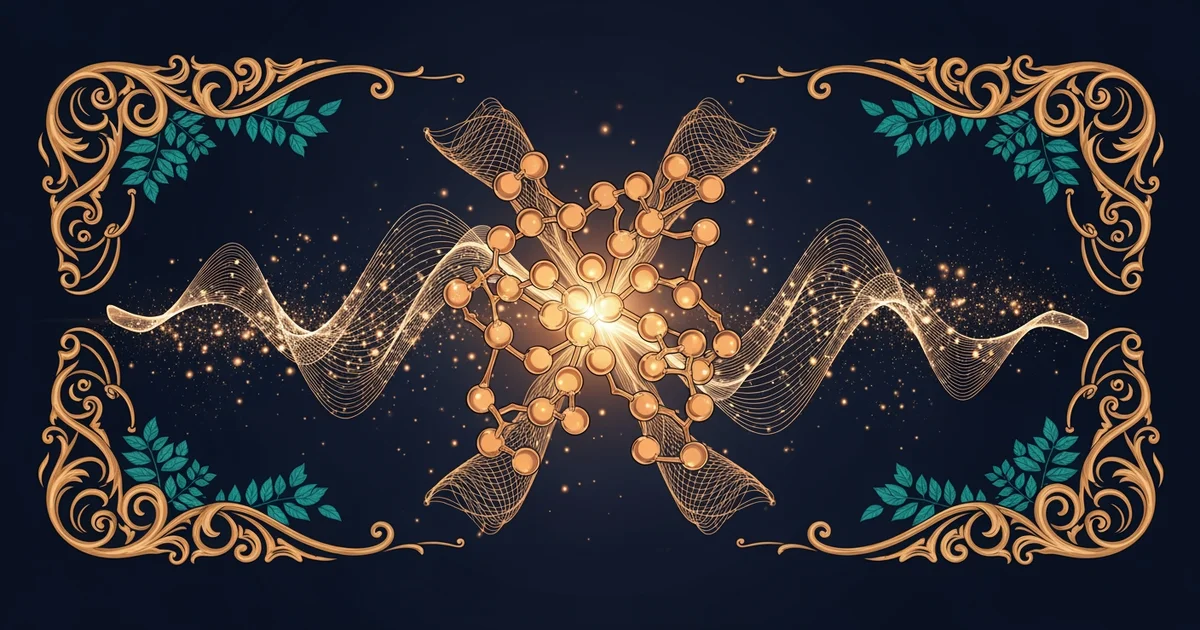
The Nature of Quantum Connections
When particles interact in specific ways, they form a unified system that cannot be described as two separate parts. You can think of this like two players in a game of chess who share one brain, where moving one piece forces a reaction from the other instantly. Because they are entangled, measuring the state of one particle immediately reveals the state of its partner, even if they are miles apart. This connection does not rely on sending signals through space, which means the interaction happens faster than light could travel between them. Scientists observe this behavior in tiny atomic structures, suggesting that living organisms might use these links to process information efficiently. Without this deep, invisible bond, the complex coordination required for life might be impossible to sustain at such high speeds.
Key term: Entanglement — a physical phenomenon where particles become linked such that the state of one instantly influences the state of the other.
Because these delicate connections are easily disrupted, quantum systems require a special environment to maintain their state. This leads us to the concept of coherence, which describes how long a quantum system can hold its wave-like properties. If a particle loses its coherence, it stops acting like a wave and starts behaving like a standard object in our daily world. Maintaining coherence is like keeping a spinning top perfectly balanced on a needle point, where even a tiny nudge from the environment causes it to fall. In biological systems, maintaining this balance is crucial for tasks like energy transfer or sensing magnetic fields. If the environment is too warm or noisy, the fragile quantum state breaks down, and the system loses its special abilities.
Maintaining Balance in Biological Systems
Since biological environments are warm and chaotic, researchers often wonder how these systems protect their quantum states from collapsing. The answer lies in how molecules are structured to shield themselves from external noise, allowing coherence to persist just long enough for biological work to happen. We can compare this to a musician playing a melody in a busy subway station, where they must focus intensely to keep the rhythm steady against the surrounding noise. If the musician loses their focus, the melody dissolves into random sound, just as a quantum system loses its coherence when exposed to environmental interference. By carefully managing their internal structure, living cells create small pockets of stability where these quantum processes can thrive without being destroyed by heat or vibration.
To understand the difference between these states, we can look at how they function within a system:
- Quantum Entanglement provides a direct, instantaneous link between two or more particles, allowing them to act as a single unit regardless of the distance separating them in space.
- Quantum Coherence acts as the timeframe during which a particle retains its wave-like nature, allowing it to exist in multiple states simultaneously to perform complex calculations or movements.
- Environmental Decoherence represents the process where outside interference forces a quantum system to choose a single state, effectively ending the special quantum behavior and returning the system to classical physics.
These principles demonstrate that the microscopic world is far more interconnected than our eyes suggest. By studying how coherence persists in nature, we gain insight into the hidden mechanics of life itself. The ability to sustain these states allows biological processes to operate with a level of precision that classical physics simply cannot explain. As we continue to map these interactions, we discover that the building blocks of life are not just passive matter, but active participants in a vast, interconnected quantum web.
Quantum entanglement and coherence allow living systems to maintain synchronized states that enable efficient biological coordination across microscopic distances.
The next Station introduces The Role of Enzymes, which determines how these delicate quantum processes influence the chemical reactions that sustain living organisms.