
Rights in Conflict
Imagine two people standing on a narrow bridge who both need to cross at the same time. If one person steps forward, the other must step back to avoid a collision on the path. This simple physical struggle represents the core challenge of human rights in our modern world. When two people claim the same space, we must decide whose claim takes priority in that moment. Rights are not always isolated bubbles that exist without touching other people or their needs.
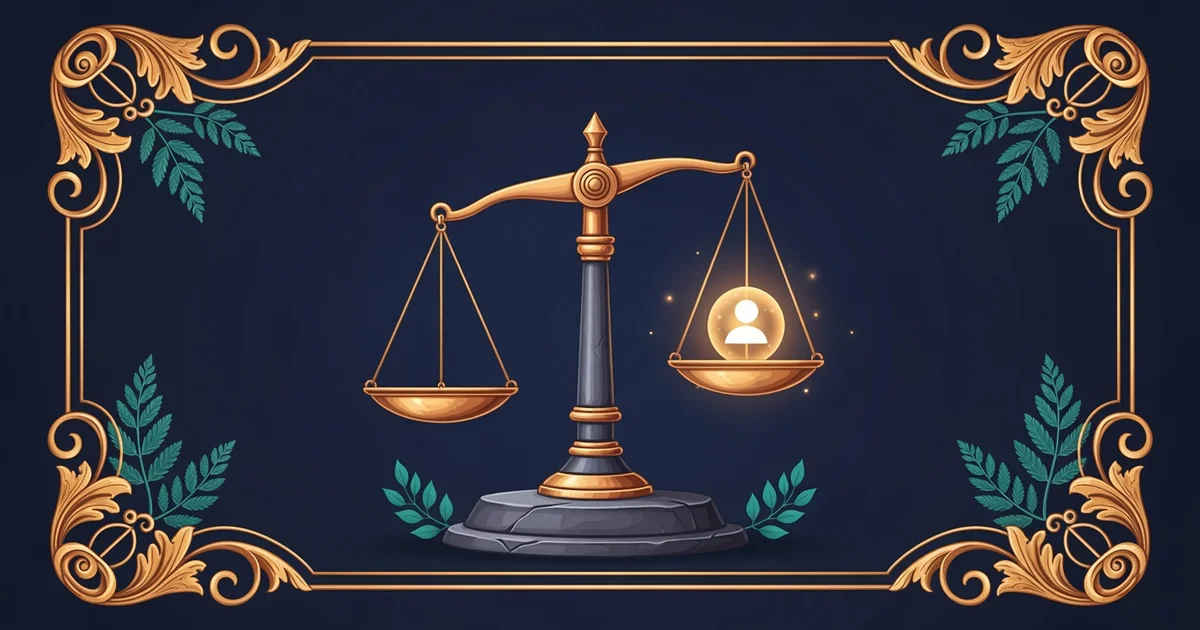
Navigating Competing Claims
When we talk about rights, we often assume they exist in a vacuum where everyone has total freedom. However, human rights frequently overlap in ways that create tension between different groups or individuals. A person might claim a right to free speech, while another person claims a right to be protected from harmful or hateful language. These two claims occupy the same space and cannot both be fully satisfied at once. We must use a framework to decide which right should take precedence in that specific situation.
Key term: Rights conflict — a situation where the exercise of one person's right limits or prevents the exercise of another person's right.
Think of this process like managing a busy city intersection during a major power outage. Traffic lights usually tell us who goes first to keep the flow moving smoothly for everyone involved. Without those lights, drivers must rely on a set of rules to prevent accidents and keep the traffic from stopping entirely. We must prioritize certain movements to ensure that the entire system does not collapse into a total gridlock of competing interests.
Balancing Interests Through Ethical Logic
To resolve these conflicts, we often look for the path that minimizes harm to the greatest number of people. We might evaluate the severity of the impact if one right is restricted for a short period. If one person loses a minor convenience while another person loses a fundamental protection, the choice becomes clearer. This is not about choosing winners and losers, but about finding the most stable balance for the community. We use formal logic to test if our choices remain fair for everyone involved in the struggle.
When we evaluate these conflicts, we often use specific criteria to determine the outcome:
- The scale of impact measures how many people will suffer if a certain right is denied during the conflict.
- The duration of the restriction determines if the limit on a right is temporary or if it will last forever.
- The necessity of the action checks if there is any other way to resolve the problem without limiting someone.
When we apply these criteria, we can see that not all rights are equal in every single situation. Some rights serve as the foundation for all other rights, such as the right to life or safety. If we allow these foundational rights to be overridden, the entire structure of human rights begins to crumble. We must therefore protect these core rights first, even if it means limiting less essential freedoms for a short time.
| Right Category | Primary Goal | Example of Conflict |
|---|---|---|
| Personal Safety | Protecting life | Self-defense vs. harm |
| Public Order | Keeping peace | Protest vs. traffic |
| Individual Speech | Expressing views | Opinion vs. harassment |
This table helps us visualize how different categories of rights might pull in opposite directions during a crisis. By identifying the goal of each right, we can better understand why they might clash in a real-world scenario. The goal is to keep the system functioning while respecting the dignity of every person who is involved in the dispute. We must remain flexible as we apply these rules to new problems that arise in our changing world.
Resolving rights conflicts requires us to weigh competing claims against the need for a stable and fair society for everyone involved.
But what does it look like in practice when the state must choose between two valid claims?