
The Invention of the Arch
Imagine standing under a heavy stone doorway and feeling the immense pressure of the ceiling pushing down on your head. If you place a flat stone beam across two vertical pillars, the weight of the roof pushes straight down, often causing the stone to crack or snap under the strain. Ancient builders faced this constant struggle when they tried to create wide, open spaces inside their massive stone temples or grand public halls. They needed a way to distribute that crushing weight away from the center to prevent their heavy roofs from collapsing on the people inside. This challenge led to the brilliant invention of the arch, a curved structure that turns downward pressure into outward force.
The Mechanics of Structural Compression
To understand how an arch works, you must first visualize the way gravity interacts with construction materials like stone or brick. Unlike wood, which can bend slightly without breaking, stone is incredibly strong when it is squeezed but quite weak when it is pulled apart or bent. The arch solves this by using a curved shape to guide the weight of the structure down along the sides of the opening. Instead of the weight pressing directly on the center of a flat beam, the arch forces the load to flow through the curved blocks toward the ground. This clever redirection of force allows builders to span much wider gaps than the simple post and lintel system ever could.
Key term: Keystone — the central, wedge-shaped stone at the very top of an arch that locks all other pieces into position.
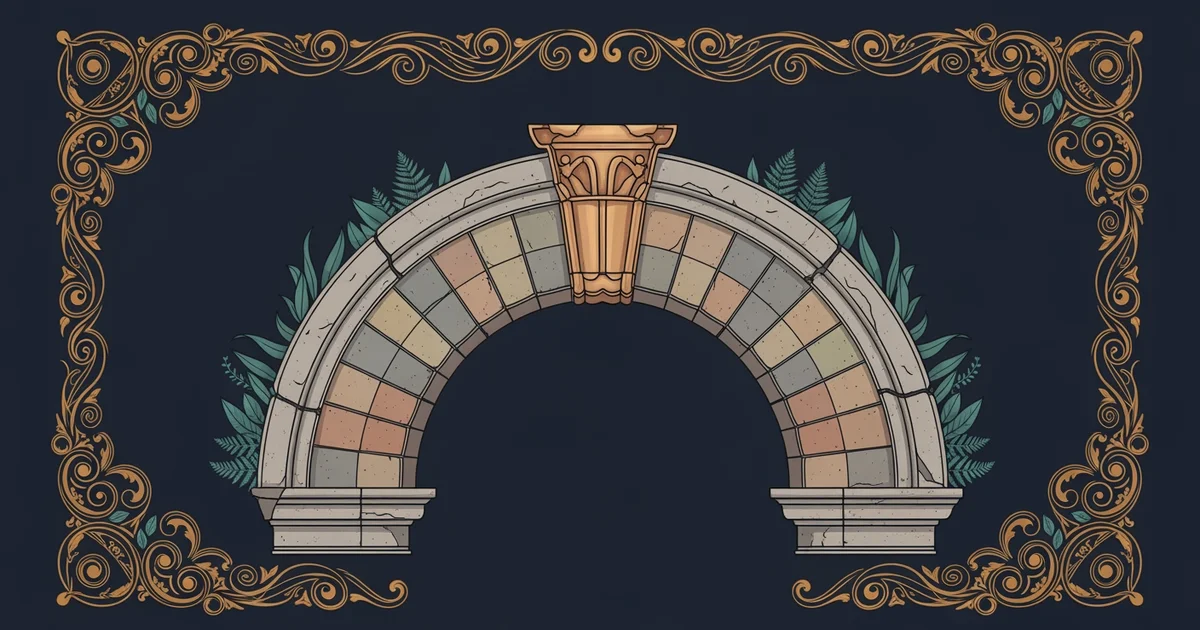
When builders construct an arch, they place the stones in a curved row, starting from both sides and moving toward the middle. The final piece they insert is the keystone, which acts as the ultimate locking mechanism for the entire structure. Without this wedge, the other stones would simply fall inward due to gravity because there would be nothing to hold them in place. Once the keystone is set, it presses against the neighboring stones, transferring the weight to the supports below. You can think of the arch like a group of people holding hands in a circle to support a heavy object placed in the center. If one person lets go, the entire circle breaks, but when everyone holds tight, the weight is shared across the whole group.
Distributing Weight Through Geometry
Once the arch is complete, the physical forces at play create a stable environment that can last for thousands of years. The weight of the walls above the arch pushes down on the keystone, which then pushes against the next stones in the curve. This creates a chain reaction of pressure that travels down the entire arch until it reaches the base. Builders must ensure that the side supports are thick and strong enough to handle this outward pushing force, which is often called thrust. If the supports are too thin, they will push outward and cause the arch to flatten or collapse entirely under the weight.
To manage these forces effectively, ancient architects often used several distinct components to ensure the stability of the arch:
- Voussoirs are the wedge-shaped blocks that form the curve of the arch and transfer the weight down to the ground.
- Abutments are the massive, heavy walls located at the base of the arch that counteract the outward thrust of the structure.
- Springing points represent the exact location where the curve of the arch begins to rise from the vertical support pillars.
These elements work together to create a balanced system where every stone plays a role in holding up the roof. By using this geometry, builders moved away from relying on the strength of a single beam and started using the collective strength of many interconnected pieces. This shift represents one of the most important breakthroughs in the history of human construction and design. It allowed for the creation of massive arenas, long bridges, and soaring aqueducts that still stand today as a testament to this simple yet effective physics principle. The arch effectively turns the enemy of architecture, which is gravity, into a tool for stability.
The keystone serves as the essential locking mechanism that redirects downward weight into lateral force, allowing stone structures to span wide gaps without breaking.
The next Station introduces mortar and binding agents, which determine how these individual stone components remain permanently fixed in their positions.