
Bernoulli Equation
Imagine a river narrowing suddenly as it flows between two large stone boulders. The water speeds up as it squeezes through that tight space before slowing down again. This simple observation captures the essence of how fluids behave when they move through a changing path. Understanding this relationship helps engineers design everything from racing cars to water pipes. By studying these shifts in motion, we learn how energy moves through a system without being lost.
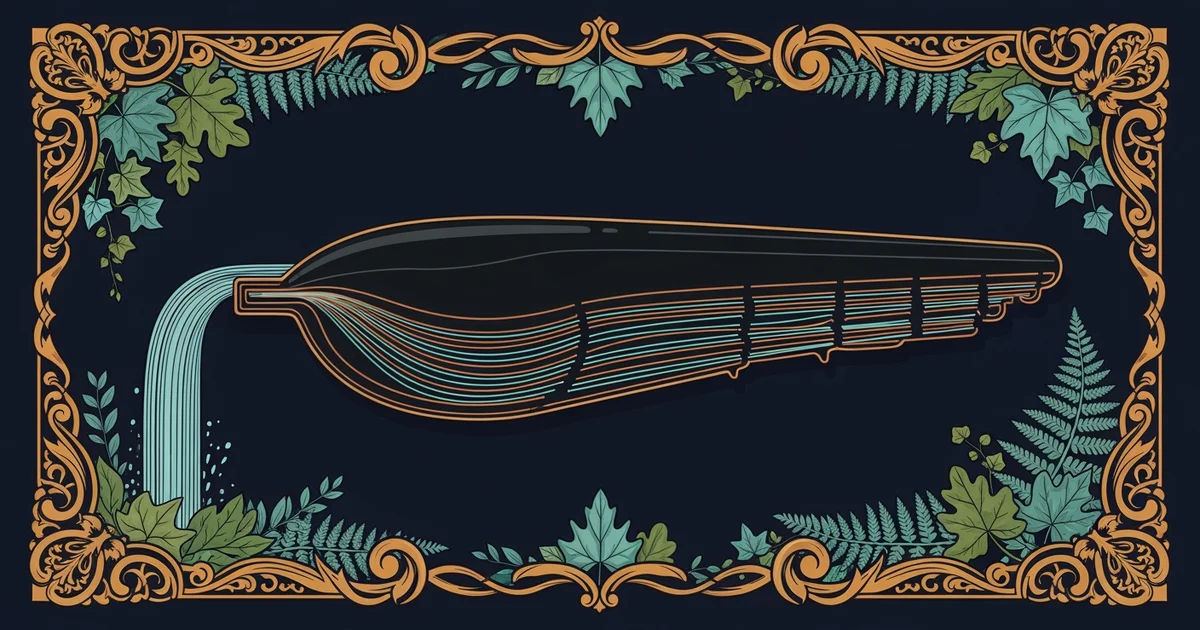
The Relationship Between Pressure and Velocity
When a fluid moves through a pipe, it must obey the law of conservation of energy. This means that the total energy within the fluid remains constant throughout its journey. The Bernoulli equation describes this balance by linking the speed of the fluid to its internal pressure. If the fluid speeds up, the pressure inside the stream must drop to keep the total energy level steady. Think of this like a busy store checkout line where people must move faster to avoid a bottleneck. When the line moves quickly, the density of people decreases because they spread out to maintain the flow. Similarly, high-speed fluid molecules spread out, which results in lower pressure against the pipe walls.
Key term: Bernoulli equation — a mathematical statement showing that as fluid speed increases, the internal pressure within that fluid decreases.
This trade-off between speed and pressure is a fundamental rule in mechanical engineering. Engineers use this concept to control how liquids travel through complex machine parts. If they need to increase the speed of a coolant, they might narrow the pipe to force the fluid to accelerate. They know that this change will lower the pressure at that specific point in the system. This allows them to predict how a machine will perform under different operating conditions. Without this knowledge, designing efficient cooling systems or fuel delivery lines would be impossible. The math provides a clear map for how energy shifts from one form to another.
Applying Energy Conservation to Fluid Flow
To see how this works in real life, we can look at how different parts of a fluid system behave. The following list explains the primary factors that influence how a fluid travels through a pipe:
- Velocity represents the speed of the fluid, which increases when the pipe diameter becomes smaller during the flow process.
- Static pressure acts as the potential energy of the fluid, which decreases when the fluid speed rises to maintain balance.
- Elevation changes can also affect the total energy, as gravity pulls on the fluid if it moves up or down.
When these factors change, the system must adjust to ensure that energy is never created or destroyed. This is similar to a budget where you have a fixed amount of money to spend each month. If you decide to spend more on rent, you must spend less on food to keep your total spending the same. In fluid dynamics, if the velocity increases, the pressure must decrease to keep the energy total constant. This rigid balance allows us to calculate exactly how a pump will push water through a tall building. We can determine the pressure required at the bottom to reach the top floors.
| Feature | Effect on Flow | Energy Change |
|---|---|---|
| Narrowing | Speed increases | Pressure drops |
| Widening | Speed decreases | Pressure rises |
| Lifting | Height increases | Potential rises |
This table shows how changing the shape of a path forces the fluid to trade one type of energy for another. By adjusting these physical features, engineers can manipulate the flow to suit the needs of the machine. Whether they are moving air through a jet engine or water through a city, the rules remain the same. The fluid will always adjust its internal state to satisfy the conservation of energy. Mastery of these principles allows for the creation of safer and more powerful mechanical systems. We rely on these calculations every time we turn on a faucet or drive a vehicle.
Total energy in a fluid system stays constant by balancing changes in speed against changes in pressure.
But what does it look like when the flow becomes chaotic and stops following these smooth patterns?
Want this with sources you can check?
Premium Learning Paths for Engineering & Robotics are researched against open-access libraries — PubMed, arXiv, government databases, and more — with their distinctive claims cited to real sources and independently checked.
See what Premium includes