
Wing Box Mechanics
Imagine a heavy bird landing on a thin branch that must hold its full weight. The branch bends downward, yet it does not snap because its internal fibers resist the force. Aircraft wings function with this same resilience when they face the heavy loads of flight. Engineers design the inner structure of a wing to act like a rigid box. This structure carries the weight of the plane while resisting the twisting forces of the wind. Without this design, the wings would simply fold under the pressure of the air during flight.
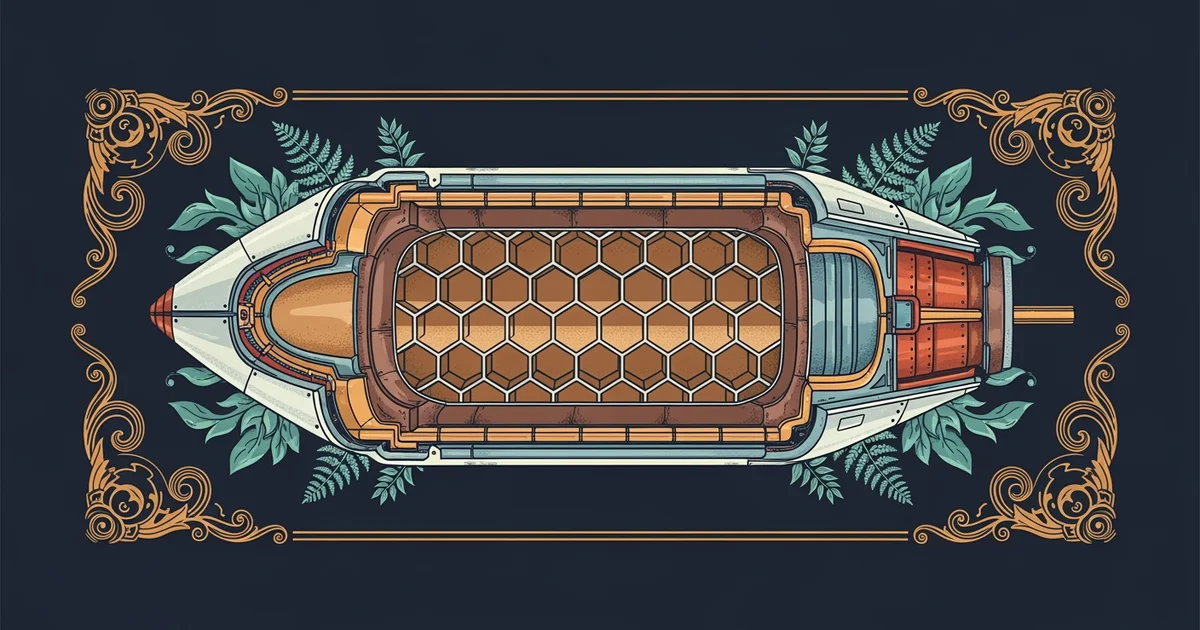
Structural Mechanics of the Wing Box
When a plane takes off, the air pushes up against the wings to create lift. This upward force acts like a hand pushing on the end of a long, thin ruler. The root of the wing, where it meets the main body, experiences the greatest stress. Engineers use a wing box to handle these heavy forces. This box consists of top and bottom panels connected by strong vertical walls called spars. The top panel resists compression while the bottom panel handles tension from the bending. Think of this like a thick book held flat between your two hands at the ends. If you try to bend the book, the top pages compress while the bottom pages stretch apart. The wing box keeps the shape stable so the skin of the wing stays smooth and safe.
Key term: Bending moment — the internal force that causes a structure to rotate or bend when an external load is applied.
Engineers must calculate the exact bending moment at every point along the wing span. If they underestimate these forces, the wing might bend too much and eventually fail under stress. The spars act as the main support beams that carry the load back to the fuselage. These spars are usually made of strong, lightweight metals that can flex without breaking. They are shaped like an 'I' beam to provide maximum strength with minimum weight. The following list describes the primary components that work together to maintain structural integrity:
- The upper spar cap carries the compression load as the wing bends upward during flight maneuvers.
- The lower spar cap handles the tension load which prevents the wing from pulling apart under stress.
- The vertical web connects the two caps while preventing the entire structure from buckling under heavy loads.
Calculating Forces and Material Limits
Designers perform complex math to ensure the wing box survives the most extreme flight conditions. They model the wing as a cantilever beam fixed at one end and free at the other. By knowing the lift distribution, they can find the force at any point along the spar. The goal is to keep the stress below the yield point of the chosen materials. If the stress exceeds this limit, the metal will deform permanently instead of snapping back. Designers balance the need for strength against the need to keep the plane light enough to fly. Using advanced materials allows engineers to build thinner wings that still handle massive bending moments.
| Component | Primary Function | Stress Type | Material Role |
|---|---|---|---|
| Spar Cap | Support bending | Tension/Comp | Main strength |
| Spar Web | Shear resistance | Shear force | Shape support |
| Wing Skin | Aerodynamic flow | Local stress | Surface load |
This table shows how different parts of the wing box share the burden of flight loads. Each part plays a specific role in keeping the aircraft stable during high-speed turns. When the wing bends, the spar caps take the brunt of the force while the webs keep the caps aligned. Proper material selection ensures that the wing can handle thousands of cycles of bending without fatigue. Engineers test these designs in wind tunnels to verify their math before building the actual plane. This process ensures that every wing box meets the strict safety standards required for modern air travel.
Engineers design wing boxes as hollow, reinforced beams to balance the need for extreme structural strength with the requirement for low weight.
Now that we understand how wings handle bending, how do we manage the mechanical systems that allow the plane to touch down safely?