
Mixing in Microchannels
Imagine trying to stir a cup of thick honey using only a single, tiny needle. You would find that the honey barely moves because the small space prevents the spoon-like motion needed for mixing. This physical struggle highlights a major challenge in modern science when moving liquids through tiny channels. In these microscopic paths, fluids behave differently than the water flowing from your kitchen faucet at home. Understanding how to mix these fluids is essential for building better medical devices and chemical reactors. Without effective mixing, the chemicals inside your microchip stay separated like oil and water, which stops the needed reactions from starting.
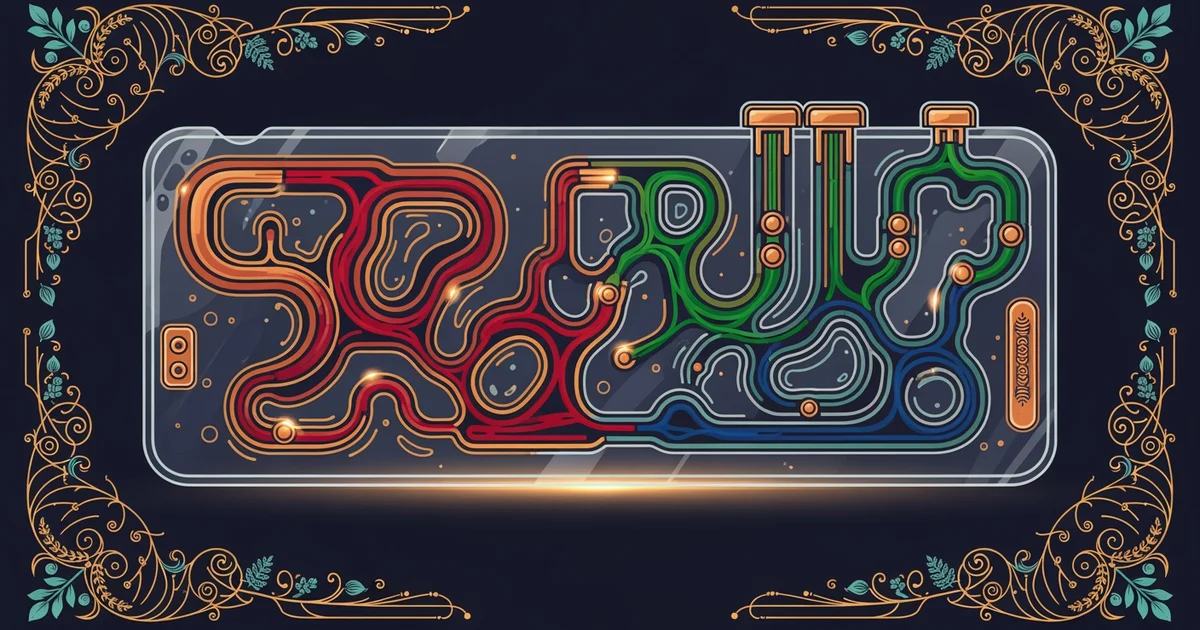
The Physics of Microscale Flow
When fluids move through these tiny spaces, they travel in a very smooth and predictable manner. We call this type of movement laminar flow, where layers of liquid slide past each other without any chaotic swirling. In larger pipes, water usually moves in a turbulent way that naturally mixes different liquids together quite quickly. However, the tiny walls of a microchannel act like a straight track that forces the liquid to stay in organized lines. Because there is no turbulence to stir the ingredients together, the molecules must rely on a slower process to meet one another. This natural spreading of molecules from high concentration areas to low concentration areas is known as diffusion. Think of diffusion like a single drop of food coloring spreading slowly through a still glass of water. It takes a long time to color the whole glass because the dye must travel across the space molecule by molecule.
Key term: Diffusion — the process where molecules move from an area of high concentration to an area of low concentration until they are evenly spread.
Overcoming Mixing Barriers
Since diffusion is naturally slow, scientists must find clever ways to speed up the mixing process within microchips. One common strategy involves changing the shape of the channel to force the fluid layers to fold over themselves. By adding small bumps or grooves to the walls of the channel, we create tiny obstacles that disrupt the smooth flow. These obstacles act like a speed bump on a road, forcing the liquid to change direction and swirl slightly as it passes by. This process increases the surface area where the two liquids touch, which allows diffusion to happen much faster than in a straight, smooth channel. You can compare this to folding a piece of paper many times to make it fit into a small envelope. Each fold creates more layers in a smaller space, which brings the different parts of the paper closer together. By folding the fluid streams, we reduce the distance that molecules must travel to reach their partners.
Methods for Enhancing Fluid Interaction
Engineers use several specific geometric designs to improve how liquids blend inside these small systems. These designs ensure that the chemicals react efficiently before they reach the end of the chip. The following list outlines how different channel geometries assist in the mixing process:
- Serpentine channels force the fluid to turn repeatedly, which creates internal pressure differences that push the liquid layers against each other to improve contact.
- Herringbone grooves carved into the floor of the channel create tiny vortices that pull the fluid from the bottom to the top and back again.
- T-junction intersections allow two separate streams to collide at a sharp angle, which creates an immediate impact that helps break apart the smooth laminar layers.
These methods transform a passive system into an active one, even without using moving parts like pumps or fans. By carefully choosing the right geometry for the task, scientists can control exactly how and where the chemical reaction occurs. This level of control is vital for producing sensitive medicines that require perfect mixing to remain stable and effective. The ability to manipulate fluid behavior at this scale is a cornerstone of modern molecular science and technology.
Efficient mixing in microchannels depends on using specific geometric shapes to overcome the slow nature of molecular diffusion in smooth laminar flows.
The next Station introduces reaction kinetics basics, which determines how the speed of these chemical reactions works once the fluids have finally mixed.