
The Architecture of the Atom
Imagine you are standing in a crowded stadium where every single person represents a piece of matter. You cannot see the individuals from a distance, but their collective movement creates the patterns we observe in the world around us. This invisible structure of tiny particles defines how objects behave, from the solid ground beneath your feet to the air filling your lungs. By understanding these building blocks, we unlock the secrets of why substances react, combine, or stay the same. Atoms act as the foundation for this complex cosmic architecture, holding the blueprint for everything that exists.
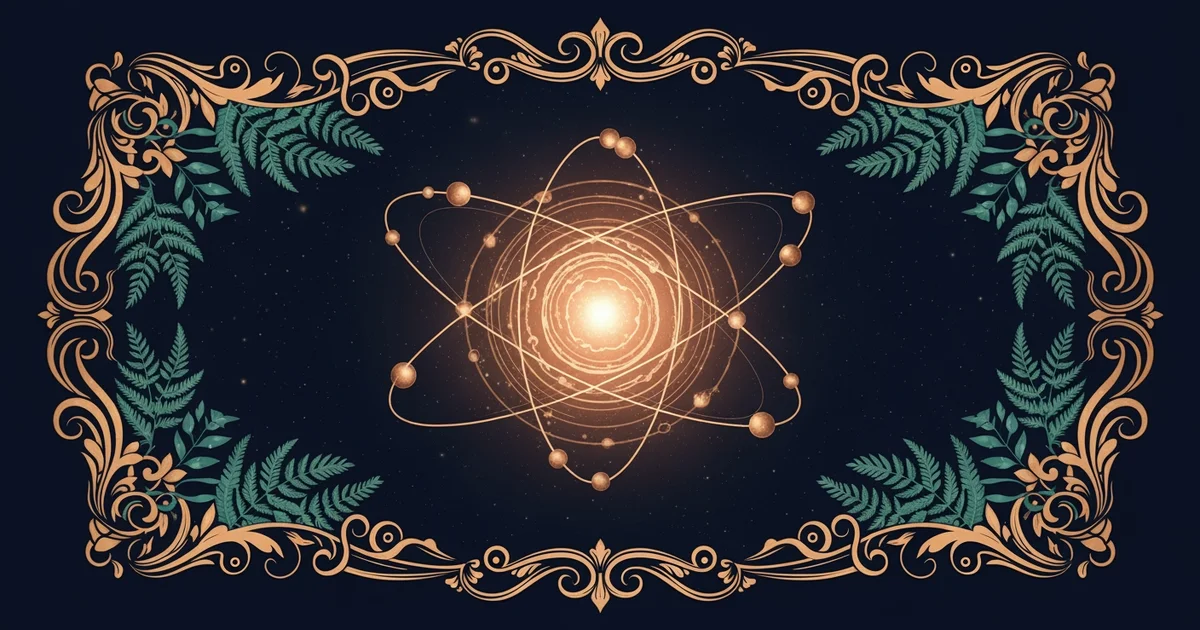
The Components of Atomic Architecture
At the center of every atom lies a dense, heavy core known as the nucleus. This central hub contains two types of particles that provide most of the mass for the entire structure. The first particle, the proton, carries a positive electrical charge that anchors the identity of the element. If you change the number of protons, you change the element itself entirely. The second particle, the neutron, sits alongside the protons to provide stability without adding any electrical charge. Think of these particles like heavy luggage in a car trunk, providing the weight needed to keep the vehicle steady on the road. Without these central components, the atom would lack the mass and the identity required to form stable matter.
Key term: Nucleus — the dense central region of an atom consisting of protons and neutrons that holds nearly all the atomic mass.
Surrounding this heavy center are the much lighter particles called electrons. These tiny entities carry a negative electrical charge and move through the space around the nucleus constantly. While the protons and neutrons stay packed tightly in the middle, electrons occupy vast regions of space relative to their small size. You can compare this arrangement to a solar system where the sun represents the nucleus and the planets represent the electrons. The electrons do not follow perfect circular paths, but they remain bound to the nucleus by the attraction between opposite charges. This balance between the positive center and the negative outer layers keeps the atom intact.
Patterns in Atomic Organization
Understanding how these parts fit together explains why matter follows predictable rules in our universe. The number of protons determines the atomic number, which acts like an identification card for each element. Electrons determine how atoms interact with neighbors, as they are the parts that touch or shift during chemical changes. When atoms have the same number of protons but different numbers of neutrons, they are called isotopes. This variation does not change the chemical behavior of the atom, but it does alter the total mass of the particle. The following table summarizes these three primary subatomic particles and their roles within the structure:
| Particle | Location | Electrical Charge | Primary Function |
|---|---|---|---|
| Proton | Nucleus | Positive | Defines element identity |
| Neutron | Nucleus | Neutral | Provides nuclear stability |
| Electron | Outer shell | Negative | Governs chemical reactions |
This division of labor allows the universe to maintain order through simple, repeatable patterns. Protons provide the identity, neutrons provide the stability, and electrons provide the reactivity required for change. Every substance you touch is made of these repeating units, arranged in specific ways to create different materials. By observing these three components, scientists can predict how different elements will behave when they meet. This predictability is the reason we can design new medicines, build stronger materials, and understand the chemical history of our planet. The architecture of the atom is not just a theoretical concept, but the functional reality of our physical world.
The specific arrangement and interaction of protons, neutrons, and electrons create the unique properties that allow all matter to exist in predictable forms.
By mastering this foundation, you will gain the skills to explore how these building blocks combine to form the complex molecules that shape our daily lives.