
Radio Signal Detection
Imagine standing in a crowded room where everyone shouts at once, yet you must identify a single whisper from across the hall. This challenge mirrors the task of finding intelligent signals within the chaotic noise of our vast, expanding universe. Astronomers use massive dishes to capture faint energy waves that travel through the cold dark of space. These waves carry information across billions of miles, potentially revealing the presence of civilizations far beyond our own solar system.
Capturing Cosmic Radio Waves
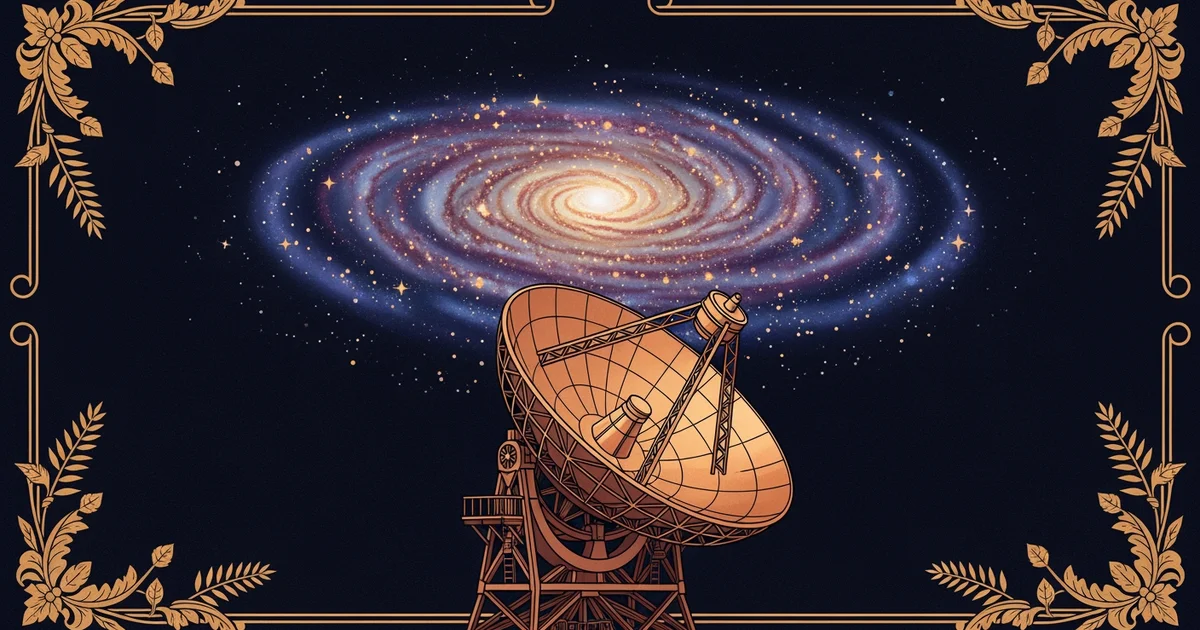
To detect these signals, researchers rely on a radio telescope, which functions like a giant ear turned toward the heavens. These structures do not capture visible light, but instead focus invisible electromagnetic waves onto a sensitive receiver. The process requires precise alignment, as the signals are often weaker than the background radiation produced by natural cosmic events. By pointing these dishes at specific stars, scientists filter out local interference, such as human-made radio broadcasts or cellular signals. This filtering creates a cleaner data set, allowing computers to scan for patterns that do not occur in nature. If a sequence of pulses repeats with mathematical regularity, it might indicate a non-natural origin.
Key term: Radio telescope — a specialized instrument designed to collect and amplify faint electromagnetic waves emitted by distant objects in space.
Think of this process like listening for a specific melody inside a massive, noisy shopping mall. The mall represents the galaxy, filled with the loud hum of stars, gas clouds, and swirling dust that create constant background noise. Most of the energy we detect is simply the static of a natural, chaotic universe working through its normal cycles. However, if you heard a clear, rhythmic song playing over that static, you would know a human—or something else—had placed it there. We search for that song, hoping to find a signature that stands out from the random background of space.
Analyzing Signal Patterns and Data
Once the telescope captures these waves, the focus shifts to processing the massive amount of incoming digital information. Computers perform complex calculations to separate genuine signals from the interference of our own atmosphere or local electronics. The data must be analyzed for specific traits that suggest intentional design rather than random cosmic outbursts. Scientists look for narrow-band signals, which are concentrated in a very specific frequency range, unlike the broad spectrum of light emitted by stars. This narrow focus is a hallmark of technology, as natural sources rarely emit energy in such a tight, controlled manner.
| Signal Type | Origin Source | Frequency Profile | Detection Goal |
|---|---|---|---|
| Pulsar | Rotating Star | Broad and erratic | Physics study |
| Background | Big Bang | Uniformly spread | Cosmic history |
| Intelligent | Technology | Narrow and sharp | Finding life |
These categories help researchers prioritize which signals deserve further study by the global scientific community. By comparing incoming data against these known profiles, we can quickly discard natural phenomena that mimic potential messages. This systematic approach ensures that we do not waste limited telescope time on events that have simple, natural explanations. The search remains a slow, patient effort that requires scanning millions of possible channels across the sky every single day.
- Data Collection: The antenna gathers weak electromagnetic energy from a target star system.
- Noise Reduction: Advanced hardware removes local interference caused by human technology on Earth.
- Pattern Recognition: Software algorithms scan the remaining data for non-random, repeating mathematical sequences.
- Verification: Independent observatories confirm the signal to rule out equipment errors or false alarms.
This workflow allows us to systematically narrow our focus toward the most promising candidates in the galaxy. While we have yet to confirm a message from another world, the technology continues to improve every year. As our sensors become more sensitive, our ability to detect even the faintest whispers from distant civilizations grows stronger. Every scan brings us closer to understanding our place among the stars and the potential neighbors we have yet to meet.
Finding extraterrestrial intelligence requires distinguishing intentional, narrow-band signals from the overwhelming, natural static of the cosmic background.
The next Station introduces the Fermi Paradox, which determines how the lack of detected signals impacts our understanding of life in the universe.