
The Cosmic Cycle
Imagine a vast, silent factory that recycles every single piece of material across the entire universe. This cosmic engine takes the remnants of dying stars and turns them into new worlds, moons, and eventually, the very atoms in your own body.
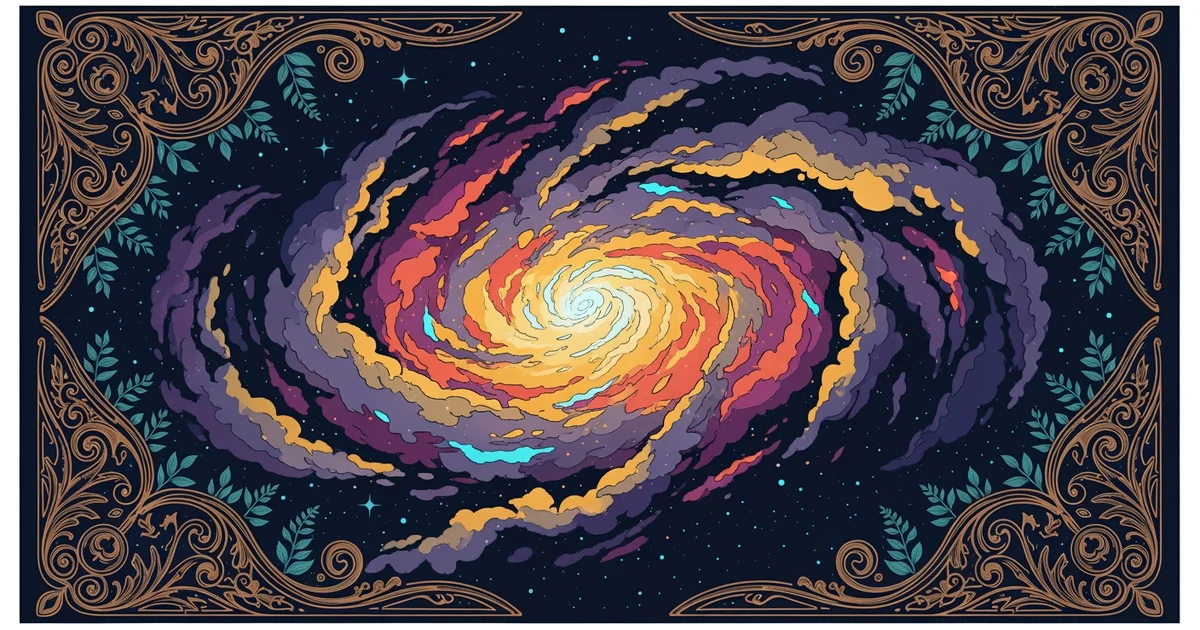
The Life Cycle of Stellar Matter
Stars function like massive, high-pressure furnaces that fuse simple elements into heavy materials over millions of years. When a star reaches the end of its life, it does not simply vanish into the dark void of space. Instead, it undergoes a violent transformation that ejects its contents back into the surrounding environment as gas and dust. This material eventually drifts through the cold, empty vacuum of space until gravity pulls it together into dense clouds. These clouds act like raw inventory waiting for a new production run to begin. Just as a factory repurposes scrap metal to build new tools, the universe uses these recycled elements to forge fresh planetary systems. This ongoing process ensures that matter never truly disappears but instead changes form to support new structures.
Key term: Nucleosynthesis — the cosmic process by which stars create heavy elements from lighter ones through the intense heat and pressure of nuclear fusion.
This cycle relies on the constant movement of matter from the centers of stars to the cold regions of space. After a supernova explosion, the newly formed elements spread out, cooling down as they travel across vast distances. These particles eventually mix with interstellar gases to form a rich, chemical soup. This mixture contains the fundamental building blocks necessary for complex chemistry to emerge. By analyzing these clouds, we see that the universe is essentially a closed loop of material exchange. Every atom of carbon or iron in your hand once existed within the core of a star that exploded long ago. This connection links our biological existence to the physical evolution of the galaxy itself.
From Stardust to Surface Chemistry
Once gravity concentrates this recycled material into a spinning disk, the conditions become right for the birth of a planetary surface. As the disk cools, the gas and dust begin to clump together into tiny grains that slowly grow into larger rocks. This process mimics how a snowball gathers more ice as it rolls down a mountain, eventually becoming a solid object. These planets capture the chemical legacy of their parent stars, incorporating water, carbon, and minerals into their crusts. The following table summarizes how different stellar remnants contribute to the chemical diversity of a new planet:
| Stellar Source | Primary Elements Provided | Role in Planetary Formation |
|---|---|---|
| Low Mass Stars | Carbon and Nitrogen | Essential for organic life |
| High Mass Stars | Oxygen and Magnesium | Building blocks for rock |
| Supernova Events | Iron and Heavy Metals | Core formation and magnetism |
This systematic distribution explains why some planets are rocky while others consist mainly of gas. The specific chemical composition of a planet depends heavily on the type of stars that lived and died in its neighborhood. By studying these patterns, researchers can predict which star systems are most likely to host rocky, earth-like worlds. This synthesis of astronomy and chemistry shows that our existence is a direct result of ancient stellar activity. We are essentially the final products of a multi-billion-year manufacturing process that spans the entire galaxy.
How do these recycled elements interact to form life after they land on a planet? This question remains one of the greatest challenges for modern science, as we try to bridge the gap between simple chemistry and complex biology. While we understand the movement of atoms, the exact moment when non-living matter becomes a self-replicating system is still a mystery. Researchers continue to explore whether the vacuum of space acts as a laboratory for these reactions before they even reach a planet. By looking at the cosmic cycle, we see that the universe is not just empty space but a dynamic, evolving system that constantly builds upon its own history.
The cosmic cycle transforms simple stellar debris into the complex chemical foundations required for planetary life and biological evolution.
The next phase of our journey will explore how humans intend to venture beyond our home planet to study these distant frontiers firsthand.